Output
A run produces up to three files, all sharing the observation file’s base name and written to the folder set by [output] path.
| File | Contents |
|---|---|
.pos | Per-epoch receiver position, GPS clock, and ZTD estimates. |
.log | Debug log: cycle slips, outliers, residuals, ambiguity resolution. |
.stat | RTKLIB-format residuals/estimates for visualization. |
pos file
Section titled “pos file”The primary output: one record per processed epoch with the station coordinates (ECEF, metres), their standard deviations, the receiver clock error (GPS), and the zenith total delay (ZTD). Coordinates, clock errors, and ZTD estimates are all in metres, and the coordinate frame follows the satellite orbit product used for processing.

log file
Section titled “log file”Written whenever [output] level is not off. It records cycle-slip and outlier detection plus a priori and post-fit residuals. Each message begins with a letter giving its severity:
| Tag | Level |
|---|---|
T | Trace |
D | Debug |
I | Information |
W | Warning |
E | Error |
C | Critical |
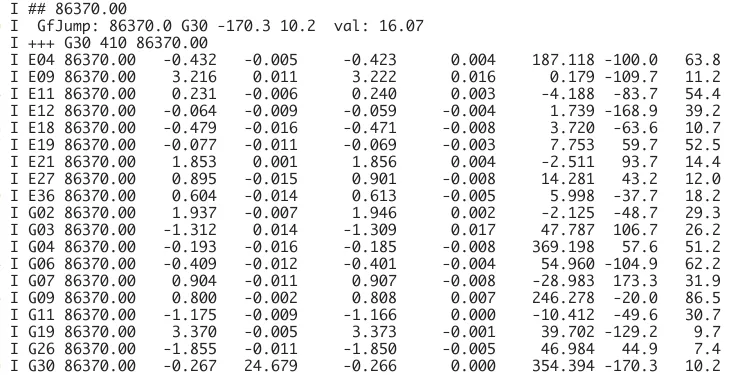
Reading the excerpt above: a cycle slip was detected at epoch 86370.0 (seconds of day). After the PRN come the satellite’s azimuth, elevation, and the between-epoch difference of its geometry-free (GF) combination. The next line reports that a new ambiguity parameter — numbered 410 — was introduced at that epoch. The lines that follow cover every satellite available at the epoch: after the PRN and the epoch time come the a priori pseudorange and carrier-phase residuals, the corresponding post-fit residuals, the ambiguity estimate in cycles, and the azimuth and elevation.
stat file
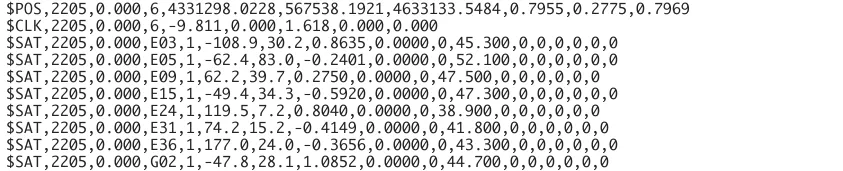
Section titled “stat file”Always generated, in the stat format of RTKLIB, for visualization. PPPx writes the $POS, $CLK, and $SAT records; the format is documented in RTKLIB’s source code. The one difference is that $CLK values are in metres (not nanoseconds) and are absolute clock errors per GNSS system rather than inter-system biases.
See Visualization for plotting these files.